|
|
Study of the observability of MSSM neutral Higgs bosons A and H in the four-b final state: gg->bbA/H, A/H->2b in the mass range 200 < MA < 800 GeV/c2. Production cross-section and branching ratios were calculated with FeynHiggs2.3.2. program by S. Heinemeyer, W. Hollik, G. Weiglein in the mhmax scenario with mu=200 GeV/c2. Signal (for 4 values of MA: 200, 500, 600 and 800GeV/c2 with tan beta value 50) and QCD background were generated with PYTHIA without pile-up; detector simulation was performed using the fast simulation framework of CMS, FAMOS. Signal is also studied with the full GEANT4 CMS detector simulation which allows to validate the fast simulation samples.
This channel is triggered at Level 1 by the standard single and multi-jet triggers. At High Level, the inclusive single b-jet trigger stream has been used. The implementation of the High Level double b-jet trigger and relaxing the jet energy thresholds could improve the observability of the signal, especially for low mass Higgs boson (MA~ 200 GeV/c2).
The off-line selection includes two hard jets with E1T > 90, 200, 220, 260 GeV and E2T > 80, 180, 200, 240 GeV for MA = 200, 500, 600, 800 GeV/c2 resp. Additionally two soft jets of ET > 30 GeV were required. The cut on the 4th ET jet is motivated by reliability of the analysis simulation without pile-up. Subsequently, the jets were required to be in the range of the tracker acceptance, |eta| < 2.4. Combined b tagging as described in PTDR Vol I has been used. At least three b-tagged jets (with discriminant variable > 2), among the 4 highest ET jets, are requested in the analysis; two of them must be the two highest ET jets. Finally, the centrality shape variable, using the four highest ET jets in the event, is used to discriminate between signal and background, given its independence from the signal mass. The analysis uses the discrimination power of this variable to reject background events with values lower than 0.7.
Given the low S/B ratio and the similarities of the signal and background distributions, a careful evaluation of the background has to be performed. The best source of background events will come from real data samples, when available, as it is being done at the Tevatron experiments. The QCD multi-jet background will be determined from data by normalising distributions outside of the signal region, once the mass of the Higgs is known from other channels for example. Data will be also used to extract the background shape with possibly the help of Monte-Carlo.
The discovery potential of this channel is limited by the low signal-to-background ratio and the similarity of the signal and background distribution shapes. So far, it is not known how well the background can be measured at LHC, thus it is difficult to make predictions about the possibility to observe the MSSM Higgs bosons in the four-b final state.
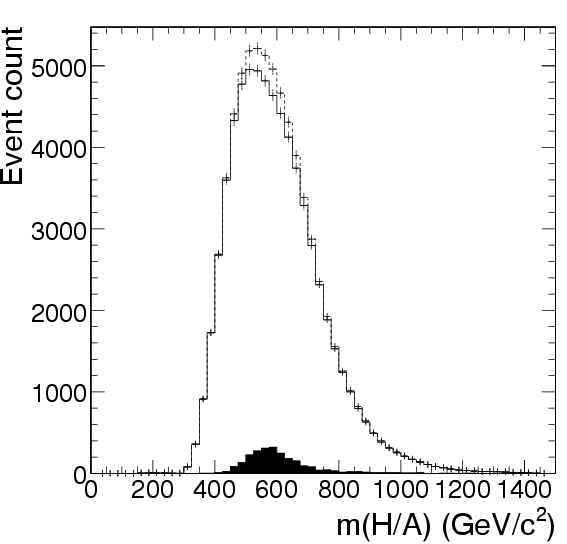 |
The Higgs boson mass distributions after all selections for the signal of MA=
600 GeV/c2, tan beta=50 (black in foreground), background (solid line) and
signal plus background (dashed line) for 60 fb-1.The criterion for the presence of signal
is based on the distribution of the reconstructed Higgs
boson mass, considering as mass estimator the invariant mass distribution of the two leading
ET jets. The signal significance, S/sqrt(B) is calculated in the mass window which maximises
this ratio. Reference : J. Fernandez CMS Note 2006-080 |
 |
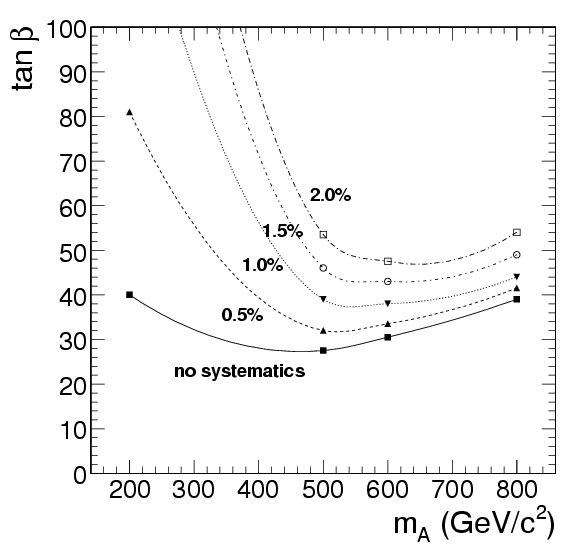 |
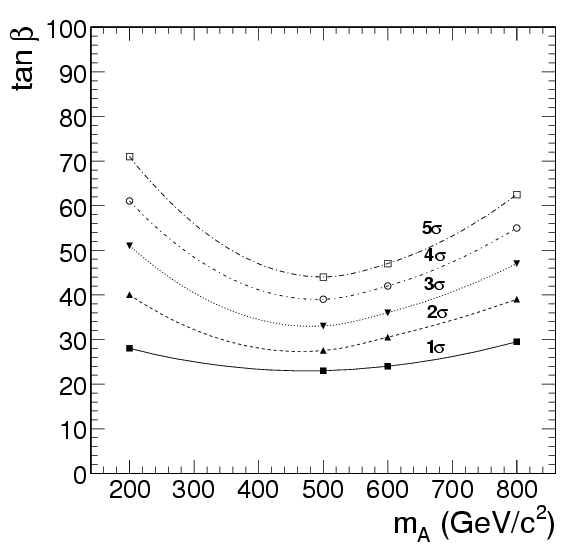
Left plot: the one, two, three, four and five sigma discovery contours
with 60 fb-1. Significance was calculated as S/sqrt(B). Right plot: two
sigma discovery contours with 60 fb-1 when different values
of the background uncertainty are taken into account. Significance was
calculated as S/sqrt(B+(eB)2), where e was varied as 0.005,
0.01, 0.015 and 0.02. Reference : J. Fernandez CMS Note 2006-080. |
Comments: please contact Sasha Nikitenko
